
I’m originally from China, but if you travel 7,000 kilometers to the other side of the Asian continent, you’ll reach my current home: Israel. On the surface, Middle Eastern culture and Chinese culture are at complete opposite poles with nothing in common. Whether it’s music, religion, or language, little connection can be formed between the two. But with a closer look at the subject of food, you’ll uncover a number of surprising similarities.
Having been exposed to Chinese culture in my household, I’ve grown up eating homemade traditional dishes just like any other local Beijinger. However, the outside world bombarded me with the contrasting flavor of Israel, which took me almost a year to adapt to. Over time, the tastes of the two countries began to merge in my mind. Some may call their similarities a mere coincidence, but I’m inclined to believe it’s one of the many signs that nationality and ethnicity aside, we’re not so different after all.
Kebab vs. Chuan’r

Kebab is the umbrella term for all meats and vegetables grilled on a skewer in Middle Eastern food. The most popular in Israel are beef and lamb kebabs. My family prefers to buy frozen, uncooked ones because grilled kebabs sold in shops may be the tastiest, but definitely aren’t the most healthy. Common vegetables include mushrooms, eggplants, bell peppers, and onions, each adding a unique touch.
You may be thinking, isn’t this the same as the chuan’r (串儿 chuàn ér) on Beijing sidewalks we’re all familiar with? Well, that’s absolutely correct! Chinese chuan’r is most traditional in Xinjiang, where my dad’s side is from. Just like kebabs, it involves grilling on a skewer. However, the main difference is Chinese chuan’r are typically lamb or chicken cut up into significantly smaller pieces. The ingredients utilized, such as cumin for chuan’r, give them distinct flavors too.
Shakshuka vs. Tomato and Egg
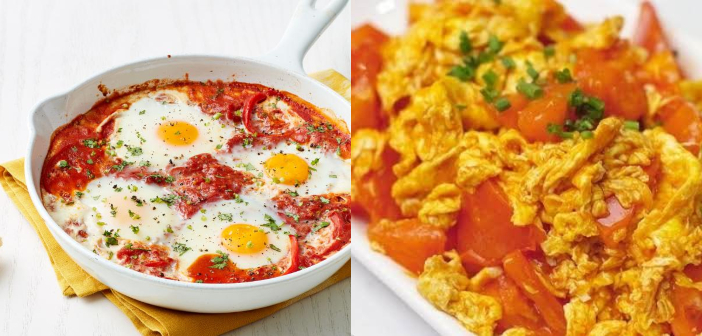
Shakshuka derives from the Arabic word for “everything mixed up”. Of all Israeli egg dishes, this one by far takes the lead in popularity. Essentially, it’s poached eggs simmered in tomatoes and spices, commonly served in a metal pan. Personally, shakshuka isn’t one of my top picks, but the liquid-inside of the eggs and oozing juice of the tomatoes are beyond appealing to Israelis.
It’s not hard to guess which Chinese dish Shakshukas correspond with. It’s the popular tomato and egg (西红柿炒鸡蛋 xī hóng shì chaǒ jī dàn), more professionally known as stir-fried tomato and scrambled eggs.
Despite the completely dissimilar cooking processes, the ingredients and red-yellow color scheme have bound them together as one category. Both are considered main courses, with tomato and egg being viewed as more basic and simple while shakshukas are viewed as advanced.
Hummus vs. Sesame Sauce
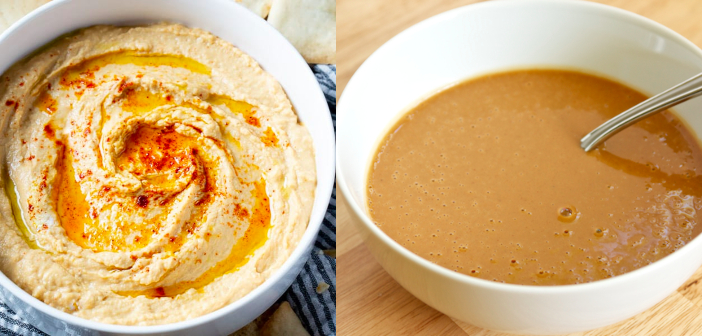
To a non-Middle-Easterner, hummus is perhaps the most familiar food from this list. It’s a sauce or spread made from mashed chickpeas, garlic, lemon juice, tahini, and occasionally other spices too. Hummus can be served with almost anything in Israel; it’s practically the core of every meal. I remember years ago, the father of a boy in my class had won the Guinness World Record for the largest plate of hummus and proceeded to open one of the hottest restaurants in the area. From this, I realized the huge role hummus plays in Middle Eastern culture.
On the other side of the spectrum is China’s sesame sauce (麻酱 má jiàng). As the name suggests, it’s made of sesame. But believe it or not, it’s entirely identical to the tahini sauce composing hummus. It’s much easier to make than hummus, but appearance-wise, they can definitely be mistaken for one another. Chinese sesame sauce tends to be eaten with hotpot specifically, but hummus, on the other hand, isn’t just for dipping, but also for spreading across bread in thick layers.
Pita Sandwich vs. Roujiamo

The pita sandwich is a combination of many foods, including hummus, as mentioned before. A pita is a circular piece of bread consisting of two layers. It’s generally cut open on one side to insert falafels, other vegetables, and to apply hummus and tahini sauce, another popular sauce in the Mediterranean.
Roujiamo (肉夹馍 ròu jiā mó), on the other hand, originated from the Shaanxi province in northwest China and is sometimes called the Chinese burger. Although not as popular as pitas are with Israelis, it’s definitely a classic all across China. The overall concept is the same: stuffing a range of ingredients inside a circular bread. However, a major difference is that pita sandwiches are typically vegetarian, while the ‘rou (肉 ròu)’ character in ‘roujiamo’ gives away the fact that meat is a crucial part of the dish. On top of that, the bread’s also much thinner and softer for pitas.
KEEP READING: “That’s Not Jianbing, It’s a Galette!” French and Chinese Cuisine in Solidarité
Photos: pamperedchef.com, ltl-shanghai.com, foodnetwork.com, justapinch.com, thekitchengirl.com, aromasian.com, cookingclassy.com, thewoksoflife.com


2 Comments
Pingback: “That’s Not Tomato & Egg, It’s a Shakshuka!” Closing the 7,000km Gap Between Chinese and Israeli Cuisine - Not For Meat Eaters
Pingback: “That’s Not Tomato & Egg, It’s a Shakshuka!” Closing the 7,000km Gap Between Chinese and Israeli Cuisine - NortheNews