
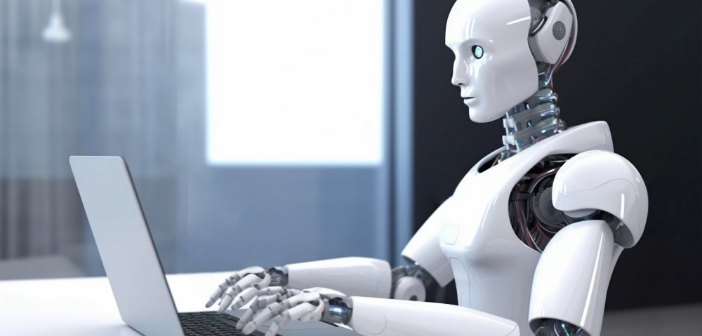
In what administrators are calling the “most ambitious pivot in educational technology since the invention of the whiteboard,” the experimental Genesis Global Academy (GGA) in Haidian District, Beijing’s very own Silicone Valley, announced today that it has begun beta testing a fleet of student-robot doubles, designed to attend classes, absorb curriculum, and socially interact on behalf of flesh-and-blood students.
The program, called Project ECHO, aims to solve a perennial problem facing international schools: student absenteeism, lack of engagement, and the logistical nightmare of getting teenagers out of bed before noon.
“The idea is simple,” explained Dr. Alexander Luther, the school’s Head of Innovation, during a press conference held via a slightly glitching hologram. “Why force a child to sit in a traffic-choked SUV for forty-five minutes to sit in a hard chair when a perfectly calibrated, AI-driven proxy can do it for them? We are beta testing robots that learn a student’s unique linguistic tics, behavioral patterns, and even their specific way of sighing dramatically when a teacher mentions homework.”
The robots, sleek white humanoid units dubbed S-1s (Student-One), are currently being piloted in three Grade 8 classrooms. According to the school, each unit is assigned to a specific student. For the first month of the beta, the robots are in “observation mode,” shadowing their human counterparts.
“It’s a little weird at first,” admitted Liam, a 14-year-old beta tester, while controlling his robot remotely from his bedroom via a gaming headset. “I named my bot Gio. It’s freaky accurate. Yesterday, it mimicked my sneeze so well that the kid next to it said ‘bless you’ without looking up. We’ve got AI everywhere nowadays, and Gio’s just taken it to the next level.”
The technology focuses heavily on linguistics. Engineers have programmed the S-1s to master the complex, evolving dialect of the modern international school student. Early demonstrations showed the robots flawlessly executing phrases such as: “This is fire,” “You’re just being salty,” and, when asked for a late assignment, “I emailed it to you yesterday, did it go to your spam?”
“The vocal inflections are spot on,” said Ms. Chen Wei, a math teacher participating in the trial. “This morning, one of the robots looked me dead in the optical sensor and said, ‘Ms. Chen, we’re not going to be tested on this, right?’ It sounded exactly like Kevin, the student it’s assigned to. I actually apologized to it before I realized what was happening.”
The ultimate goal, according to a leaked internal memo obtained by this publication, is to reach a point where students no longer need to physically attend school at all. Instead, they will “telematically inhabit” their robotic avatars, allowing them to receive a full international education from ski slopes in Switzerland, beach resorts in Phuket, or, most commonly, their own beds.
“Why disrupt the child’s natural habitat when we can bring the classroom to them?” Dr. Luther added. “The robots handle the physical presence. The student handles the learning. It’s perfect synergy.”
News of the beta test has already sent shockwaves through Beijing’s international school community. Sources indicate that representatives from Northern Academy of Beijing (NAB) and English School of Beijing, Shunyi have requested “exploratory meetings” with GGA’s tech team. Meanwhile, Birmingham College Beijing is rumored to be considering a competing model involving drone-based attendance.
“We are working out the kinks,” Dr. Luther assured. “We just pushed a software update to address the ‘sass’ parameter.”
When asked for comment on the expansion plans, a spokesperson for the Beijing Education Commission responded with a single laughing emoji before declining to elaborate.
As for the students, reactions are mixed. While many appreciate the opportunity to “attend” school in pajamas, some worry about the long-term implications.
“I mean, what’s the point of having a robot learn to be me,” said Liam, “if eventually the robot is just going to realize it’s smarter than me and just leave to go to a better school?”
The beta test is scheduled to continue through the end of the academic year, provided the robots do not unionize.
Images: FreePik